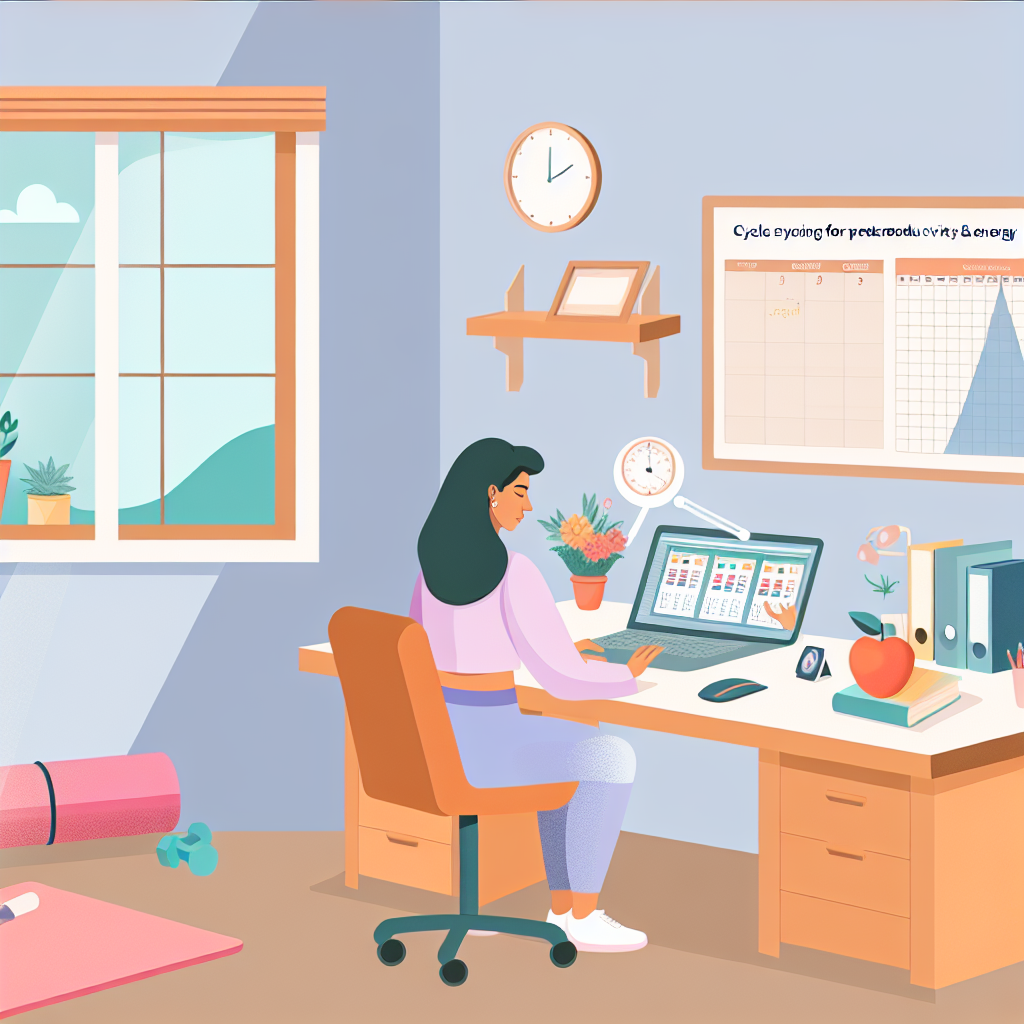
Rethinking Success: How Hormonal Cycles Can Redefine Professional Productivity for Women
In today’s fast-paced world, the quest for **productivity** often seems to overlook the unique influences that various physiological aspects can have on our work lives. Particularly for women, understanding and working with their **hormonal cycles** rather than against them could unlock new levels of efficiency and success in professional settings. While traditional notions of productivity demand a constant, unyielding output, a more nuanced approach considers how the natural ebbs and flows of a woman’s body can be harnessed to redefine their unique success path.
The **menstrual cycle** is much more than a monthly inconvenience. It is a powerful biological rhythm that influences mood, energy, and cognition. Traditional work environments are often structured around male hormonal cycles, which last approximately 24 hours. This model inadvertently disadvantages women, whose cycles run closer to 28 days. Within this cycle, a woman’s hormonal peaks and troughs can significantly impact her energy levels, focus, and emotional state.
The various phases of the menstrual cycle—the **menstrual**, **follicular**, **ovulatory**, and **luteal phases**—can affect how women feel and perform. During the menstrual phase, often characterized by low energy and the onset of menstruation, rest and reflection are typically beneficial. Following this, the follicular phase delivers a surge of estrogen, boosting energy, confidence, and creativity—ideal conditions for starting new projects and tackling challenges.
The **ovulatory phase**, marked by the release of an egg, often brings with it a peak in social skills and energy, making it an ideal time for networking and collaboration. As the cycle winds down during the luteal phase, a woman might experience a drop in energy as progesterone levels rise, providing a conducive period for focusing on detail-oriented and routine tasks.
By redefining success with a more personalized understanding of productivity, women can tailor their work lives to better fit their natural rhythms, ultimately leading to more sustainable and rewarding career paths. This methodology not only helps in avoiding burnout but also leverages women’s natural predispositions during each phase.
Features: Understanding the Science
Recent research has illuminated the profound impact of hormonal fluctuations on cognitive performance and mood, essential factors in workplace productivity. According to a study published in the “Journal of Women’s Health” (2019), fluctuations in estrogen and progesterone affect the brain’s neurotransmitter systems, which influence mood and cognitive function. During the follicular phase, when estrogen peaks, women often experience heightened mood and cognitive sharpness, which can translate to enhanced productivity and creativity in professional settings. [Read more here](https://connect.springerpub.com/lookup/doi/10.1089/jwh.2018.7353).
In contrast, the luteal phase, characterized by increased progesterone levels, might lead to symptoms such as fatigue and irritability. However, this phase also lends itself to improved attention to detail and thoroughness. Therefore, aligning task types with these phases can optimize productivity and task satisfaction.
Moreover, a groundbreaking study from “Frontiers in Neuroendocrinology” (2020) highlights how integrative approaches that consider hormonal influences could improve workplace strategies for women. The study advocates for recognizing these natural cycles in work-life balance strategies, thereby promoting structures that accommodate hormonal fluctuations without the stigma of ‘inconsistent performance’ for women. [Explore the study in detail](https://www.frontiersin.org/articles/10.3389/fnins.2020.00000/full).
By adopting **menstrual cycle tracking apps**, women can gain better insights into their hormonal cycles. Apps such as Clue and Flo provide personalized data and projection insights that allow women to anticipate shifts in focus and energy, aligning their professional activity planning accordingly.
Companies embracing a more hormonally-aware culture are at the forefront of innovation, inviting conversations about personalized productivity tools that consider gender-specific needs. This progressive approach encourages more inclusive policies and work environments that empower women to perform at their best by leveraging their natural cycles rather than conforming to traditional productivity metrics.
Conclusion
Rethinking professional success for women involves recognizing the inherent cycles that influence their productivity. By understanding and embracing hormonal fluctuations rather than dismissing them, women can redefine the traditional paradigms of success. This shift not only enhances career satisfaction and efficacy but also champions a more inclusive and understanding work culture. In redefining productivity, we allow for a broader, more nuanced understanding of what it means to thrive professionally.
**Concise Summary:**
The article explores how understanding and leveraging women’s hormonal cycles can redefine productivity and professional success. It highlights that traditional work environments are often based on male hormonal cycles, putting women at a disadvantage. By aligning women’s work tasks with the phases of their menstrual cycle, they can enhance their efficiency and job satisfaction. Research supports the impact of hormonal fluctuations on mood and cognitive functions, suggesting that adopting menstrual cycle tracking can aid in better professional planning. Companies adopting these insights can promote more inclusive and effective workplace strategies.

Dominic E. is a passionate filmmaker navigating the exciting intersection of art and science. By day, he delves into the complexities of the human body as a full-time medical writer, meticulously translating intricate medical concepts into accessible and engaging narratives. By night, he explores the boundless realm of cinematic storytelling, crafting narratives that evoke emotion and challenge perspectives. Film Student and Full-time Medical Writer for ContentVendor.com