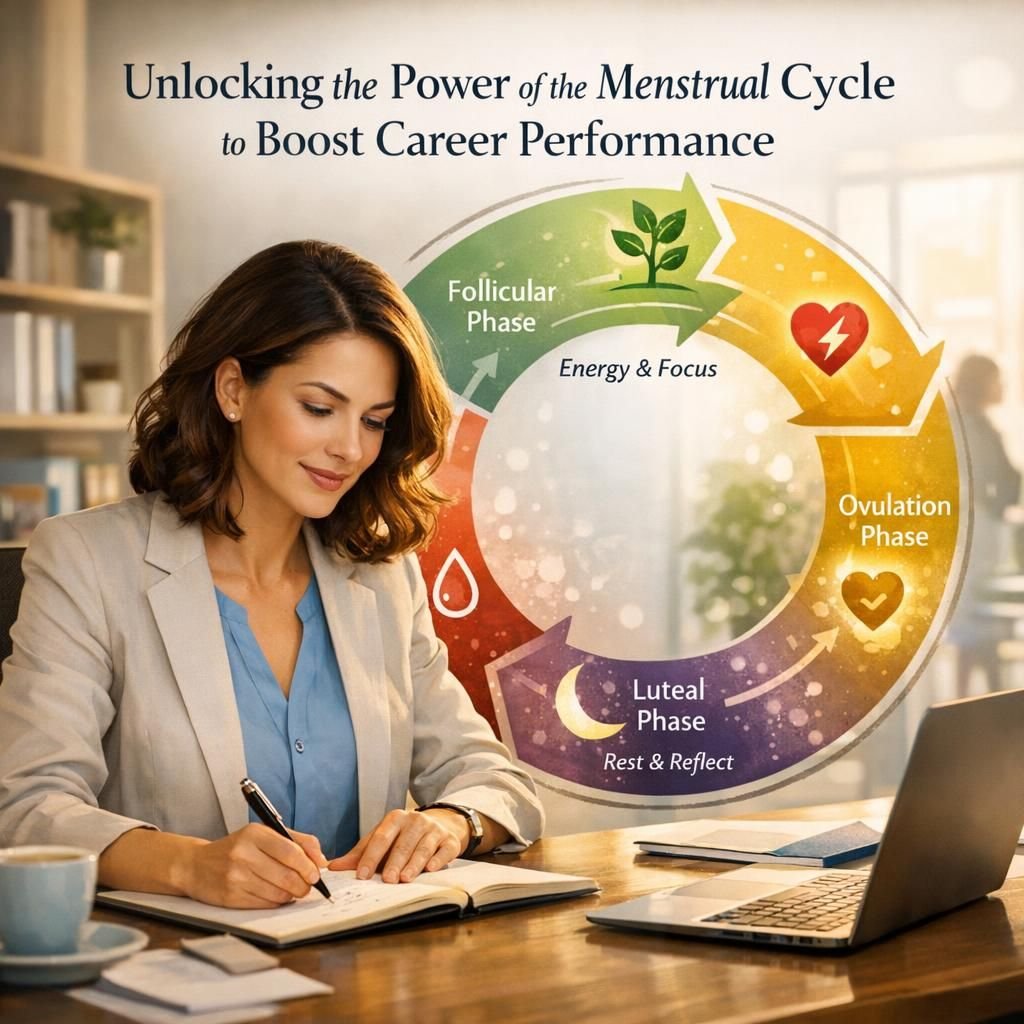
Harnessing Hormonal Intelligence: Unlocking Sustainable Female Leadership with Neuroscience and Emotional Wellbeing
Introduction
In today’s dynamic, fast-paced world, achieving a balance between personal well-being and professional success is more challenging than ever. Particularly for women, the pressures of leadership roles often intersect with **biological** and **emotional landscapes** in unique ways. **Hormonal intelligence** is becoming an increasingly significant concept, offering a pathway to enhanced personal and professional experiences. It revolves around the art of deciphering and navigating one’s hormonal cycles and emotional states to bolster **mental clarity**, **decision-making**, and **leadership capabilities**. This concept goes beyond traditional leadership paradigms by incorporating the profound insights of **neuroscience** and **emotional wellbeing** into the fabric of female empowerment.
**Hormones**, the body’s chemical messengers, have a more substantial impact on **mood**, **cognition**, and **behavior** than previously understood. **Estrogen**, **progesterone**, and **cortisol**, among others, play pivotal roles in influencing how women think, feel, and perform. By **harnessing hormonal intelligence**, women can better steer through these fluctuations, thereby enhancing their leadership potential and personal satisfaction. **Neuroscience** facilitates this by elucidating how hormonal changes impact the brain’s neural pathways, potentially altering emotional and cognitive processing.
Furthermore, integrating **emotional wellbeing** with hormonal intelligence allows female leaders to operate more sustainably. **Emotional wellbeing** involves recognizing and managing emotions and forming healthy relationships, both personally and in the workplace. This synthesis empowers women to not only top the corporate ladder but also do so with a sense of fulfillment and balance.
Such an integrative approach to leadership is not about leveling the playing field; it’s about understanding the diverse capabilities that women bring to the table and unlocking them through innovative scientific understanding. Women can achieve both competitive success and personal satisfaction by recognizing and optimizing their unique physiological and emotional strengths. This article delves into the leading-edge science and studies that help unveil the potential of **hormonal intelligence** in empowering women to lead with excellence and sustainability.
Features
Several key studies offer insights into the interplay between hormones, neuroscience, and leadership in women. A pioneering study by the European Journal of Neuroscience found that fluctuations in **estrogen** and **progesterone** significantly impact brain regions associated with emotion and executive function, such as the **prefrontal cortex** and **amygdala** ([source](https://onlinelibrary.wiley.com/journal/14609568)). This neural activity can influence decision-making, stress management, and creative thinking, which are crucial for effective leadership.
Moreover, research highlighted in **Nature Reviews Neuroscience** underscores the importance of **cortisol**, commonly known as the **stress hormone**, in **cognitive resilience**. This study demonstrated that moderate cortisol levels could enhance synaptic plasticity and neurogenesis, which are vital for learning and adaptation – essential traits for successful leaders ([source](https://www.nature.com/nrn/)). By understanding and modulating stress responses, female leaders can better navigate high-pressure environments and foster more innovative and adaptive problem-solving skills.
The integration of emotional wellbeing into leadership has also been supported by significant research. According to a study published in **Emotion**, higher **emotional intelligence** – the ability to identify, understand, and manage emotions – correlates with improved leadership efficacy ([source](https://www.apa.org/pubs/journals/emo/)). Emotionally intelligent leaders are shown to cultivate more positive organizational cultures, characterized by higher levels of team collaboration, motivation, and productivity. This research emphasizes that when women leaders align their emotional intelligence with hormonal awareness, they can not only enhance their leadership capabilities but also create more dynamic and inclusive environments.
The integration of these scientific insights with personal experiences fosters a leadership model that is both effective and holistic. This approach is reflective of a growing recognition in the corporate world that wellbeing is not simply a personal issue, but a critical component of organizational success. Female leaders who harness such multi-faceted intelligence can naturally cultivate a more engaged and resilient workforce, showing that success comes not only from breaking barriers but also from understanding and optimizing one’s inherent capabilities.
Conclusion
Harnessing hormonal intelligence, supported by advances in **neuroscience** and insights into **emotional wellbeing**, offers a profound avenue for empowering women in leadership. By embracing their unique physiological and psychological traits, women can carve out paths of personal and professional success that are both impactful and sustainable. As the scientific understanding of these areas grows, so too does the potential for more women to lead in their unique capacities, redefining success on their terms. For further exploration, refer to [European Journal of Neuroscience](https://onlinelibrary.wiley.com/journal/14609568), [Nature Reviews Neuroscience](https://www.nature.com/nrn/), and [Emotion](https://www.apa.org/pubs/journals/emo/).
**Concise Summary:** Harnessing hormonal intelligence offers an innovative way for women to enhance their leadership capabilities by understanding their hormones’ impact on cognition and behavior. Integrating insights from neuroscience and emotional wellbeing empowers women to achieve both personal fulfillment and professional success sustainably. Scientific studies highlight how hormones like estrogen, progesterone, and cortisol influence decision-making and stress management. By aligning emotional intelligence with hormonal awareness, women can cultivate more inclusive and effective leadership styles, ultimately enriching organizational cultures and redefining success.

Dominic E. is a passionate filmmaker navigating the exciting intersection of art and science. By day, he delves into the complexities of the human body as a full-time medical writer, meticulously translating intricate medical concepts into accessible and engaging narratives. By night, he explores the boundless realm of cinematic storytelling, crafting narratives that evoke emotion and challenge perspectives. Film Student and Full-time Medical Writer for ContentVendor.com